
I cannot claim the following thoughts to be entirely original, even when I arrived at them independently. They have been thought before by greater people than myself, in one form or another. This is merely a recital of some of my own random thoughts.
Continuing this disaster movie two parter I decided to do, I want to go a little more in depth into Knowing and perhaps some other movies that didn't make the cut in the Deep Impact thoughts extravaganza.
Knowing left the greatest impact on me of any disaster movie I've ever watched since or after, except for maybe Metro, which developed into trauma, while Knowing developed into a healthy sense of morbid curiosity and existentialism --I will get back to Metro later. I kind of skimped out on 2012, the most disaster-est disaster movie ever; I watched it years later on Netflix, long after my fascination with disaster movies and any potential for them to impress the little kid that I once was had gone. I did watch Geostorm in theaters, though. These movies have that signature Emmerich stupidity that come with those that I enjoy. Not so much with Knowing.
The usual disaster movies always end on a hopeful note, and contrary to what I remembered seeing most of my childhood, people do survive and rebuild civilization. I always forget this part of these movies that usually comes after the disaster. These movies have a pacing issue, which is almost inevitable when the disaster becomes the main attraction of the whole movie. In Knowing, everybody just dies from the solar flare, and that's the end of it. It is a much more interesting concept to me and, interestingly enough, helps a lot with pacing in the way it is structured. The disasters gradually build up to end with the disaster-est of them all, instead of beginning with the disaster and resolving everything from that premise.
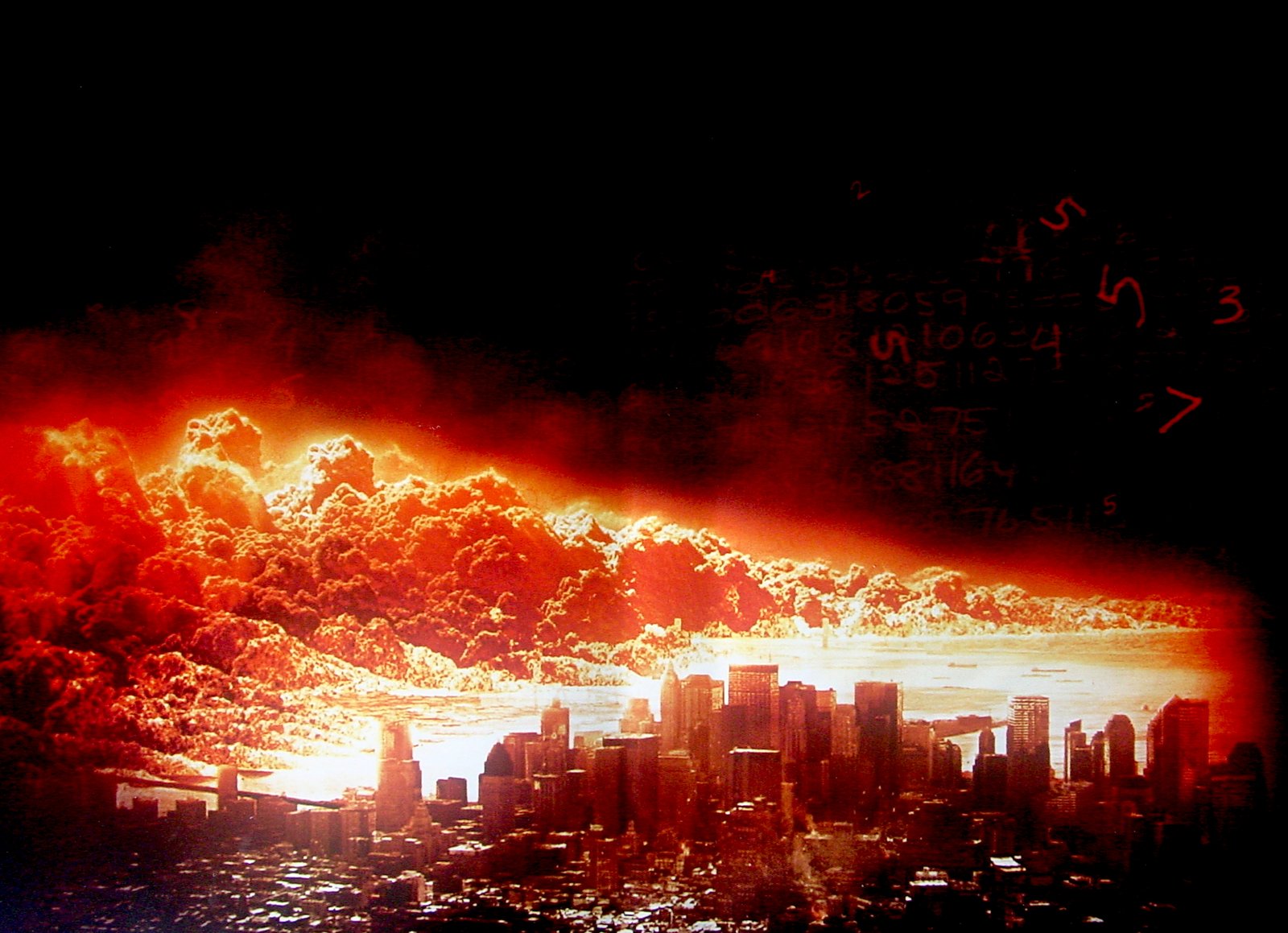
The one thing that stuck with me the most from this movie when I first watched it as a kid was this one scene where the boy looks out of the window of his room one night and everything is on fire. I had the exact same nightmares afterwards that must have lasted for weeks, until I got busy with matters of consequence. Looking at the movie again, that boy's performance is not great; it doesn't sell me on the cosmic horror anymore.
Nicolas Cage is Nicolas Cage is Nicolas Cage.
What else is there to say?The metro disaster in particular was also terrifying, more so than it ever was before, which might be related to this one Russian movie Metro (2013) I watched afterwards as a kid. It's another disaster movie, but Russian this time. You wouldn't think they'd make these, but here we are. It terrified the hell out of me, and it gave me a genuine fear of metros. I eventually grew out of it. You can watch this movie on YouTube for free and there is even an english dub of it. Rewatching parts of it now, I find it kind of funny like you would find any Emmerich disaster movie funny. Most of the humor, though, comes from it just being very Russian. I don't have a better way to describe it, you'd have to see it for yourself.
I didn't like the ending. There shouldn't have been any aliens in it, or at least not in the way they implemented them. I only now realized, while rewatching it, how many religious themes the movie has. I find their inclusion perfectly fine, and it becomes especially interesting as a tool to explore determinism and faith outside the scientific perspective. Unfortunately, the filmmakers chose to focus on biblical references rather than on an interesting argument or debate. The ending in particular was very much on the nose with the biblical references, so much so that it bordered on ridiculousness. I would definitely cut out the ending scene and change the scene where the children board the alien ship to make it more ambiguous, obscure. I would make the viewer guess if it's real or not, in the same way that when Nicolas Cage says, "Cayleb's safe," it is a little ambiguous what he means by that. I think that is what the director was originally going for, but somewhere during production, it didn't quite work out as intended.
Lastly, I want to say that ending the world with Beethoven's 7th Symphony was perhaps one of the greatest classical music choices in movie history, alongside Father Kolbe's Preaching in The Truman Show, The Blue Danube in 2001 A Space Odyssey, or Ode to Joy in Evangelion. I always associate this piece with the destruction of the world because of it.
This movie has its usual tropes and pitfalls of any other disaster movie, and I'd highly recommend reading Neil Fulwood's review about some of the issues. As a disaster movie, though, it is one of the best I know of.
Until next time!